Building a Multi-Cluster Processing (MCP) Architecture with Laravel for High-Throughput Systems
Introduction & Architecture Overview
Why Traditional Laravel Queues Break at Scale
Laravel queues work beautifully — until:
Job throughput spikes
One worker becomes a bottleneck
CPU-bound jobs block IO-bound jobs
You need horizontal isolation
When applications begin handling:
Financial transactions
Reporting generation
Webhook processing
ERP synchronization
Real-time analytics
A single queue worker pool becomes insufficient.
That’s where Multi-Cluster Processing (MCP) comes in.
What is MCP?
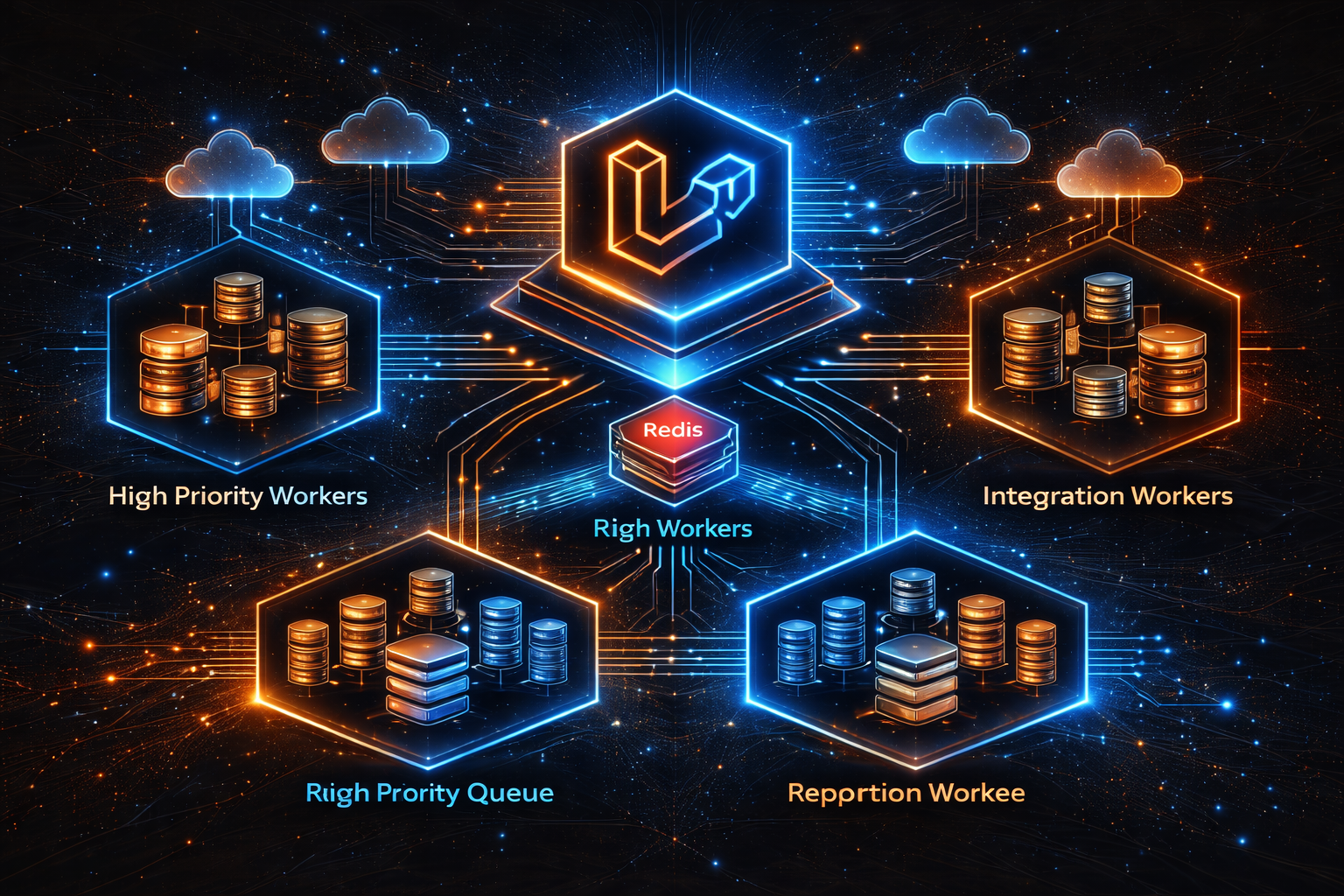
Multi-Cluster Processing is an architectural pattern where:
Different job types are isolated
Dedicated worker clusters process specific workloads
Queue backends are logically separated
Horizontal scaling is workload-aware
Instead of:
Default Queue → All Jobs → Same Worker PoolWe design:
High Priority Queue → Cluster A
Reporting Queue → Cluster B
Integration Queue → Cluster C
This avoids:
Starvation
Memory exhaustion
Queue congestion
Latency spikes
Implementing MCP in Laravel
Step 1: Define Multiple Queues
In config/queue.php:
'connections' => ['redis-high' => ['driver' => 'redis','connection' => 'default','queue' => 'high-priority','retry_after' => 90,],'redis-reporting' => ['driver' => 'redis','connection' => 'default','queue' => 'reporting','retry_after' => 300,],'redis-integrations' => ['driver' => 'redis','connection' => 'default','queue' => 'integrations','retry_after' => 120,],],Step 2: Dispatch Jobs to Specific Clusters
Example:
ProcessFinancialTransaction::dispatch($data)->onConnection('redis-high')->onQueue('high-priority');GenerateReport::dispatch($reportData)->onConnection('redis-reporting')->onQueue('reporting');SyncWithERP::dispatch($payload)->onConnection('redis-integrations')->onQueue('integrations');Now your workloads are logically separated.
Containerized Worker Clusters
Now we scale.
Instead of running:
php artisan queue:work
We create dedicated worker containers.
Docker Example
Dockerfile
FROM php:8.2-cliWORKDIR /var/wwwCOPY . .RUN docker-php-ext-install pdo pdo_mysqlCMD ["php", "artisan", "queue:work"]docker-compose.yml
version: '3.8'
services:

  high-priority-workers:
    build: .
    command: php artisan queue:work redis-high --queue=high-priority
    deploy:
      replicas: 3

  reporting-workers:
    build: .
    command: php artisan queue:work redis-reporting --queue=reporting
    deploy:
      replicas: 2

  integration-workers:
    build: .
    command: php artisan queue:work redis-integrations --queue=integrations
    deploy:
      replicas: 2
Observability & Performance Optimization
Scaling blindly is dangerous.
You need monitoring.
Supervisor Example
[program:laravel-high]
command=php artisan queue:work redis-high --queue=high-priority
autostart=true
autorestart=true
numprocs=3
redirect_stderr=true
stdout_logfile=/var/log/high.log
Horizontal Scaling Strategy
If reporting jobs spike:
docker compose up --scale reporting-workers=5
No need to touch financial cluster.
Benefits of MCP Architecture
Predictable latency
Isolation of CPU-heavy jobs
Better memory management
Fine-grained scaling
Fault isolation
Production resilience
🔥 Conclusion
Multi-Cluster Processing transforms Laravel from:
“Simple web app framework”
Into:
“Distributed processing platform capable of enterprise workloads.”
When combined with:
Redis
Docker
CI/CD
Cloud auto-scaling
You unlock a horizontally scalable job-processing architecture suitable for:
Fintech
ERP systems
Reporting platforms
SaaS products